


Logging into OKX: a practical comparison of CEX login, OKX Wallet, and Web3 flows for US traders
Imagine you need to execute a futures hedge during a sudden price swing on a Friday evening. Your laptop is open, your phone buzzes with a liquidity alert, and the clock is moving. Which route do you use to get into OKX: the centralized exchange (CEX) web login, the non-custodial OKX Web3 wallet, or the browser-extension path that bridges both worlds? The difference matters for speed, security posture, and what you can actually do once inside — especially in a U.S. regulatory and risk environment where KYC, device signals, and withdrawal policies intersect with on-chain control.
This comparison frames the choices traders encounter, explains the mechanisms that make one route faster or safer than another, and surfaces the trade-offs you rarely see summarized together: convenience versus custody, session friction versus attack surface, and regulatory gating versus permissionless access. The goal is not to endorse a single path but to make the decision practical and reproducible for routine and high-stakes situations.
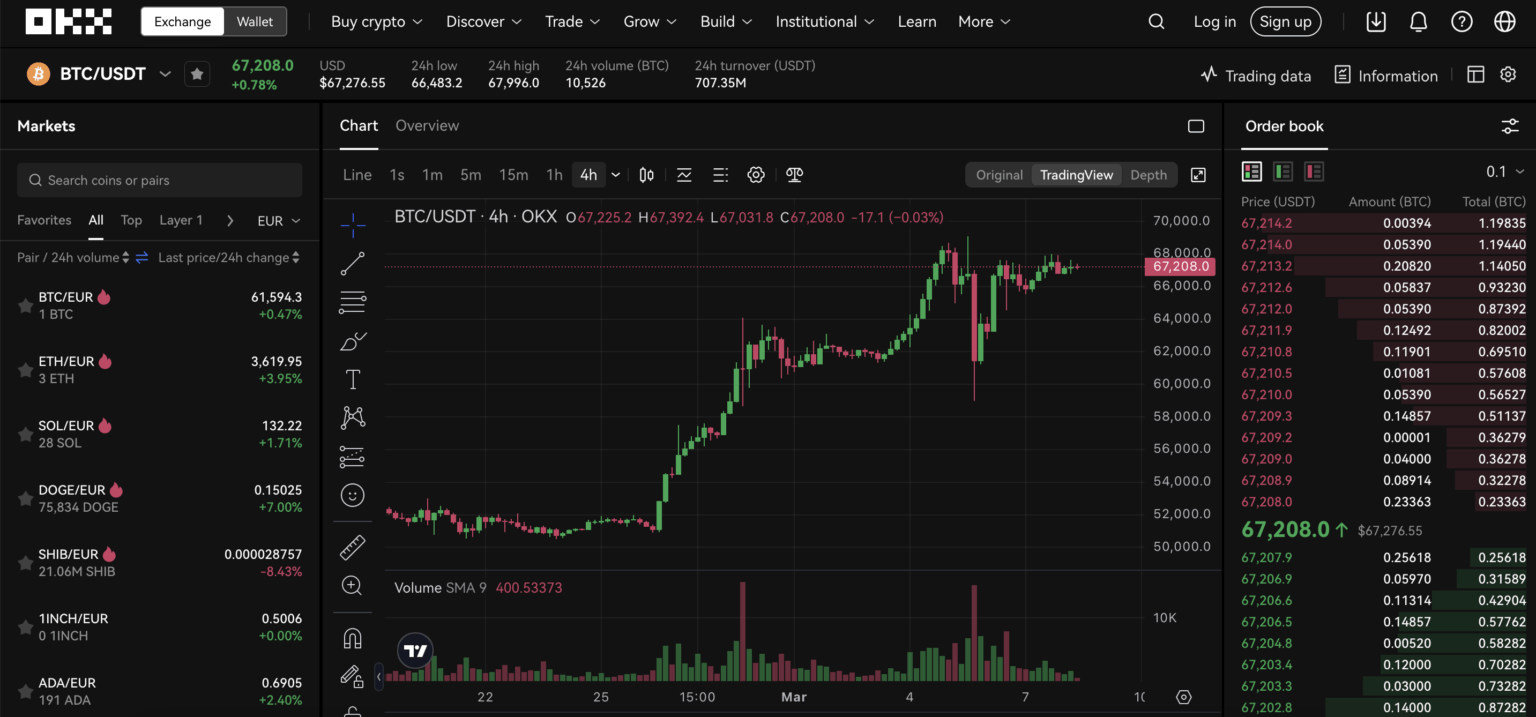
Three entry paths, three architectures
Mechanistically, there are three common ways a U.S. trader reaches OKX functionality:
– CEX web or mobile app login: traditional account-based access after email/phone, password, KYC, and 2FA. This is where spot, margin, derivatives, staking, and internal transfers are primarily handled.
– OKX Web3 wallet (non-custodial): you control private keys or a seed phrase, and you connect directly to DApps and chains. This path is separate from the exchange’s custodial ledger and is designed for direct on-chain trades, DEX interactions, and hardware wallet integration.
– Browser extension (bridge) or wallet integration: a hybrid experience enabling Web3 dApp interactions inside the OKX ecosystem while still allowing quick switching to CEX features; typically used to sign transactions in-browser and to route swaps via the DEX aggregator.
How each path works, and why it matters
CEX login: you authenticate to OKX servers. The platform uses KYC (ID + facial liveness for U.S. compliance), 2FA, and AI-driven login-threat detection. Most liquidity and derivative products — including up to 125x leverage on some perpetuals and a full suite of TradingView charting tools — sit behind this centralized session. The trade-off: faster execution and deep liquidity versus counterparty custody and regulatory gating.
OKX Web3 wallet: you hold the seed phrase; OKX provides the interface but not control. This is the path for permissionless DeFi interactions and cross-chain transfers across more than 130 supported blockchains. You get self-custody and compatibility with hardware wallets, but the boundary condition is stark: lose your seed phrase and access is irretrievable. Also, some on-exchange features (like centralized margin positions) require the CEX account rather than the non-custodial wallet.
Browser extension: it reduces friction between the two worlds. The extension can sign on-chain transactions and connect to aggregator routes (OKX DEX aggregator sources liquidity from venues like Uniswap). It’s faster for small swaps and cross-chain moves, but it increases attack surface compared with pure hardware-key usage because browser contexts are a common phishing vector.
Common myths vs. reality
Myth: Using the Web3 wallet is always more private. Reality: A non-custodial wallet gives on-chain privacy relative to an exchange’s ledger, but connecting to an exchange or using on-chain bridges can expose address activity. Moreover, KYCed exchange accounts tie identity to on-ledger deposits and withdrawals—so privacy gains are limited when moving between custody models.
Myth: The exchange’s custody means your funds are untouchable. Reality: OKX does store over 95% of assets in cold, multi-signature, air-gapped wallets, which materially reduces hacking risk for custodial funds. However, centralized custody comes with counterparty risk, and the user also faces external threats like phishing, credential compromise, and endpoint malware which cold storage does not eliminate.
Myth: Biometrics beat 2FA always. Reality: Biometric login on mobile adds convenience and device-level protection, but mandatory 2FA remains an essential guardrail for CEX accounts. Biometrics do not replace secure recovery practices; they simply reduce session friction on an enrolled device.
Decision framework — which route to pick and when
Use this simple heuristic based on task urgency, asset custody preference, and regulatory necessity:
– High-speed derivatives trade with deep order-book liquidity and margin: prefer the CEX web or mobile login with 2FA active. This minimizes slippage and gives access to leverage up to 125x on selected instruments. Note: verify position limits and recent delistings (OKX has delisted several low-liquidity spot pairs recently) to avoid route failures during execution.
– Moving large holdings you want to keep under your control or interacting with DeFi rails: use the OKX Web3 wallet with a hardware signer. The trade-off is slower recovery options and the absolute responsibility of managing seed phrases.
– Small swaps, gas-efficient cross-chain routing, or DApp UX: browser extension or integrated aggregator can be fastest. But use this for limited amounts, or only after confirming the extension and website integrity to reduce phishing risk.
Limits, failure modes, and what to watch
Several boundary conditions often trip traders: first, KYC delays. In the U.S., completing facial liveness checks and ID verification can take time; you cannot bypass those gates if withdrawals or certain product accesses are required. Second, delistings and liquidity updates (such as the recent removal of certain small-cap spot pairs) can close expected exit routes during volatility. Third, cross-environment routing (custodial to non-custodial) exposes you to on-chain slippage, bridge fees, and smart contract risk. Finally, session hijacking and phishing remain the most frequent human-facing threat; AI-based threat detection helps, but it is not foolproof.
Practical mitigation steps: maintain hardware 2FA and a separate hardware wallet for self-custody; pre-verify domain names and bookmark the login URL; keep a small hot wallet for quick execution and move residuals to cold storage; and test withdrawal and on-chain transfer flows in calm markets before relying on them under stress.
Practical checklist for a rapid, secure login when it counts
1) For CEX trades: ensure 2FA device charged and with backup codes saved offline; confirm KYC status ahead of market events; use a private network or VPN you trust; and have a small pre-funded margin buffer to avoid last-second deposits.
2) For Web3 moves: confirm your hardware wallet firmware is current; validate the recipient address off-chain; and perform a small test transfer to check gas and bridge behavior before moving large balances.
3) For browser-extension paths: pin the extension, verify its publisher, and only sign transactions you can decode in the wallet UI. If the UI shows unexpected contract approvals, stop and evaluate on-chain details externally.
What to watch next (signals, not forecasts)
– Regulatory signals in the U.S.: changes in AML/KYC expectations can increase onboarding friction or alter withdrawal policies. Watch for guidance from financial regulators rather than headlines.
– Liquidity pruning: exchanges routinely delist low-volume pairs; this reduces tail-risk but can remove quick exit channels — keep an eye on exchange notices and adjust watchlists accordingly.
– Integration between CEX and Web3: as bridges, DEX aggregators, and wallet UX improve, expect smoother cross-environment flows; but that will likely come with fresh attack vectors requiring new defensive practices.
FAQ
How do I log in quickly to execute a time-sensitive trade on OKX?
For fastest execution use the CEX web or mobile app login with 2FA already active and your KYC completed. Keep a small hot balance for quick margin or derivatives entries. If you rely on biometrics, ensure the enrolled device is charged and that fallback 2FA methods are available.
Can I use the OKX Web3 wallet to trade on the exchange directly?
The Web3 wallet is non-custodial and best for on-chain DeFi and DApp access. It does not replace the centralized account ledger for custody-dependent features like certain margin products; you’ll typically need the CEX account for those. You can, however, move assets between custody modes with bridges and internal transfers, subject to fees and on-chain risk.
Is the browser extension safe enough for daily trading?
Browser extensions are useful and fast but expand the attack surface. For routine small trades it can be acceptable if you verify the extension’s publisher and keep the extension updated. For large trades, prefer hardware-signed transactions or custodial accounts with institutional-grade protections.
What if my account login is flagged as suspicious?
OKX uses AI-driven detection to block suspicious logins; prepare for additional verification like device checks or temporary holds. If you face a lock, follow the platform’s verification flow and avoid sharing credentials on support chats outside verified channels.
Bottom line
There is no single “correct” way to get into OKX; each path — CEX login, Web3 wallet, and browser extension — embodies a different compromise among speed, custody, and security. For U.S. traders who value quick access to deep liquidity and derivatives, the centralized login with robust 2FA and completed KYC is the pragmatic default. For those prioritizing self-custody and DeFi access, the Web3 wallet and hardware keys are the right tools, provided you accept the irreversible responsibility for seed phrases. The browser extension sits between these poles: highly useful for convenience, but demanding cautious operational hygiene.
If you want a reliable starting point for the CEX route and a checklist to keep your session secure, this guide walks you through the mechanisms and trade-offs. When you’re ready to try the centralized login or compare steps practically, use this official entry page: okx sign in.

Leave a Message